

When I was at DPW last September, only two of us voted for the impact of AI on procurement improving supplier relationships – this is going to be a long term intangible benefit from AI negotiation, honestly! In multiple surveys, over 80% of people prefer negotiating with Nibble to IRL once they try it, and now the generations are shifting younger, I think this desire to interact digitally first will only accelerate.
Most of your supplier relationships are not built on golf-and-dinners. They’re built on the day-to-day experience of doing business with you: are you clear about what you need? Do you respond quickly, and behave consistently? Do you make it easy to get paid, and honour commitments?
These questions lead to the real dilemma behind the title of this article. Can an AI agent create that kind of experience repeatedly, at scale, and without turning every conversation into a cold, robotic exchange?
The answer is an emphatic yes! BUT, only if you’re precise about your use case, design your agent well (or use a great existing AI negotiation provider 😉) and are clear on what you want your agent to optimise for.
Relationships need to be nurtured through trust + reliability
Most suppliers don’t need you to be charming! They need you to be predictable.
Relationships break down when you introduce unclear requirements; become slow or inconsistent at responding, move goalposts or make exceptions that get lost in administrative processes. These operational failures can sour any business relationship.
An AI agent can build supplier relationships quickly if it improves operational trust. Not by pretending to be a human (we never allow that at Nibble), but by being better at the basics than any human could be at the same volume.
4 ways AI negotiation helps strengthen relationships
1) Speed without chaos Suppliers hate waiting. We all do, let’s be honest. Humans create delays because we’re busy, approvals take time, and inboxes are messy. An AI agent can acknowledge quickly, ask the right clarifying questions, and keep momentum without dropping the ball.
2) Consistency across many conversations A lot of supplier frustration comes from inconsistency: one buyer says one thing, another buyer says another, and finance says a third. An agent operating inside guardrails can apply the same policy every time.
3) Clearer negotiation behaviour The best negotiations are not aggressive; they’re structured clearly. An agent can be explicit about objectives, trade-offs, and constraints:
- “If we improve payment terms, we can move faster on signature.”
- “If scope stays stable, we can commit to a longer term.”
- “If you can’t move on rate, can you add service credits?”
4) Better follow-through Relationships improve when commitments turn into actions: POs, contract updates, e-signature, onboarding steps, invoice matching. AI negotiation can make sure the outcome flows straight into the process, especially when it is embedded straight into your orchestration layer.
Of course, AI negotiation isn’t going to build relationships everywhere. In strategic, bespoke, high-stakes supplier conversations, an AI agent can support, but it shouldn’t lead. At least, not yet!
The trap of a generic agent over bespoke AI negotiation
Most importantly, your AI negotiation agent should be a good negotiator. What does being a good negotiator look like?
- Stating the objective early
- Showing the structure of decision-making (“Here are the terms I can negotiate automatically today”)
- Making concessions for reasons (not randomly)
- Holding the line when needed, without being disrespectful to the user
- Closing cleanly, with a clear summary of the negotiation outcome and next steps
This is exactly where purpose-built negotiation agents outperform generic chatbots. Generic systems tend to be helpful but vague – negotiation needs controlled behavior.
What an AI agent needs to build supplier trust
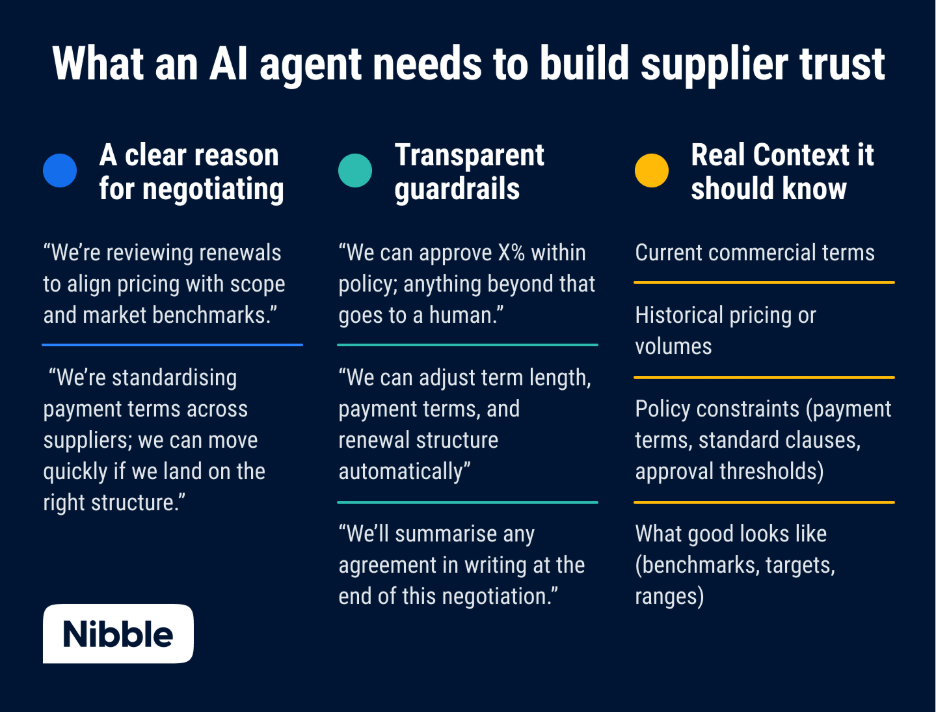
Here’s your practical checklist:
1) A clear reason for negotiating the supplier can understand
“We’re reviewing renewals to align pricing with scope and market benchmarks.”
“We’re standardising payment terms across suppliers; we can move quickly if we land on the right structure.”
2) Transparent guardrails
“We can approve X% within policy; anything beyond that goes to a human.”
“We can adjust term length, payment terms, and renewal structure automatically”
“We’ll summarise any agreement in writing at the end of this negotiation.”
3) Real context your agent should know:
- current commercial terms
- historical pricing or volumes
- policy constraints (payment terms, standard clauses, approval thresholds)
- what good looks like (benchmarks, targets, ranges)
Your key takeaway
Any good business relationship thrives on trust built through consistent, fair, structured interactions. This is what AI negotiation is designed for – particularly in tail spend and repeatable negotiations. These agents work best when they can execute negotiations (not just “assist”), operate with guardrails, and use real context in their negotiations.
Ultimately, AI agents are not going to build relationships with your suppliers by being overly friendly and charming. They’ll build relationships by making you faster, clearer, more consistent, and easier to do business with.
Just One More Thing
I have been chatting to Andrew Daley about the talent and skills needed for procurement teams to embrace opportunities from AI technology, not just AI negotiation 😉 and he has prepared an eight minute diagnostic survey to help you focus your innovation plans in 2026.
Take a look here and let me know how you get on! https://agentiqprocurement.ai/
Interested in Nibble?


